Our Vision
Minerva EYFS and Nursery School is a mainstream school where children are allowed to be and are valued for being themselves; a place without worry or obstacles in the way of their learning and development. We provide engaging opportunities that open up their world and allow them to feel safe and to take risks: regardless of whether they succeed or fail, every experience is a learning experience.
Our learning community is motivated; they laugh a lot and love working in a team, sharing their ideas and achievements. Some of us may need some additional support, which is no problem: we are always there to help and support. Minerva EYFS & Nursery School is an inclusive learning community where no one is left behind, where everyone is supported to fulfil their potential regardless of their starting points, where they are inspired to use their imagination and confidence to follow their dreams and reach the highest of their potential. Individual preferred learning styles are encouraged and developed, shaping an individual’s uniqueness.
Our children become effective communicators, developing meaningful relationships, self-regulation, resourcefulness and resilience. Our children display high levels of well-being and joy, and are supported appropriately for their age and stage of development. We recognise children get one chance at each stage of their learning journey and we pride ourselves in valuing each stage by creating a safe, happy, equitable learning environment where every individual thrives and succeeds. We instil the early building blocks they need for the next steps of their learning journeys and ultimately lifelong skills to become global citizens of the future.
I am in the Early Years. I learn from my adults and the children around me in my classroom and across the whole school. My curriculum is deliberately designed to be exciting and planned full of high-quality stories, visitors and enriching opportunities to learn. I learn to play cooperatively with my friends. I am becoming confident with speaking and listening skills. I can communicate clearly in order to work alongside my friends. My teachers set high expectations, and they prepare the environment to enable me to be ready to learn. Some of my learning is teacher-led and some is child-initiated through play. I am learning to read and write. I am confident, I can problem solve, work well with others and I am independent. My parents are involved in my learning journey. At the end of the foundation stage, I am ready for Year 1.
Implementation
- Daily routines
- Routines are embedded throughout the school day. Teachers share the routines with the children. These routines are a balance of adult-led and child-initiated. They give opportunity for a balance of experiences where children can gain new skills and knowledge and consolidate learning independently.
- Phonics
- The school follows the Unlocking Letters and Sounds phonics program.
- Phonics lessons are taught systematically.
- All resources used to support phonics are from the Unlocking Letters and Sounds phonics program to ensure fidelity to the scheme.
- Children are regularly assessed and gaps in phonic knowledge are identified quickly.
- Pre-school children begin with Phase 1 phonics and then when they are ready, they learn some Phase 2 sounds.
- Children in pre-school take-home high-quality picture books to share with their family.
- Children in Reception take home two reading books weekly that match their phonic knowledge.
- Themed Enquiry
- Themed enquiries are strategically planned to be high interest and engaging for all children. They include the EYFS prime and specific areas: Personal, Social and Emotional Development, Physical Development, Communication and Language, Literacy, Mathematics, Understanding the World and Expressive Arts and Design.
- Adults create role play areas within the classroom that link to the themed enquiry.
- Visitors, trips and enrichment opportunities are planned based on the termly themed enquiry.
- The curriculum is carefully crafted to ensure children display high levels of engagement and involvement in an environment that speaks to their curiosity, understanding and stage of development.
- Writing
- Children are encouraged to write as they play. Staff are skilled at encouraging children to use their skills in play situations so that phonic knowledge becomes easily embedded in children’s independent attempts to make meaning.
- Children learn high-quality stories and poems; they imitate them and then innovate their own versions; through drama and imaginative play, children have lots of opportunities to retell stories and write about them.
- By the end of the Early Years Foundation Stage many children can write known stories.
- Children are exposed to high-quality language.
- Maths
- Maths is planned and taught through the NCETM Mastering Number Approach.
- Maths is planned across the school year using the NCETM Mastering Number Approach.
- In Reception, other mathematical concepts such as shape, space and measure are taught continually as part of our ongoing provision and interaction, with a Friday whole-class focus.
- Maths is planned in further detail weekly.
- Children’s number and shape knowledge is regularly assessed. Gaps are identified early, and children are supported to catch up and keep up with their peers.
- Guided Reading
- Children in Reception work in ability groups with an adult weekly.
- Guided Reading texts are judiciously selected.
- Adults write notes on the guided reading proforma during the session.
- Children listen to adults read, follow the text, echo read and read independently.
- Opportunity for child-initiated and adult-led activities
- Children work in small groups with adults to consolidate and revisit previous whole-class teaching in phonics and maths; they also have their play ideas extended and supported to ensure that they have the confidence and ability to use their skills and knowledge independently.
- Online Learning Journal (Tapestry and Class Dojo) is used to capture observations of children’s learning both adult-led and child-initiated.
- Adult led writing and maths activities are often completed in children’s writers or maths books.
- High quality adult interactions that enhance children’s play
- Adults know the children in the provision and understand individual children’s stages of development.
- The environment enables children to learn independently and alongside their peers.
- Play is modelled by adults through engaging in child-led activities.
- Our classrooms are language-rich environments; this includes:
-
-
- Adults model high quality language and up-level children’s language
- Adults correct and re-cast sentences
- Language is displayed in classrooms
- First quality teaching shares key language
- Stories are shared regularly
- Children are encouraged to have back and forth interactions with adults and their peers.
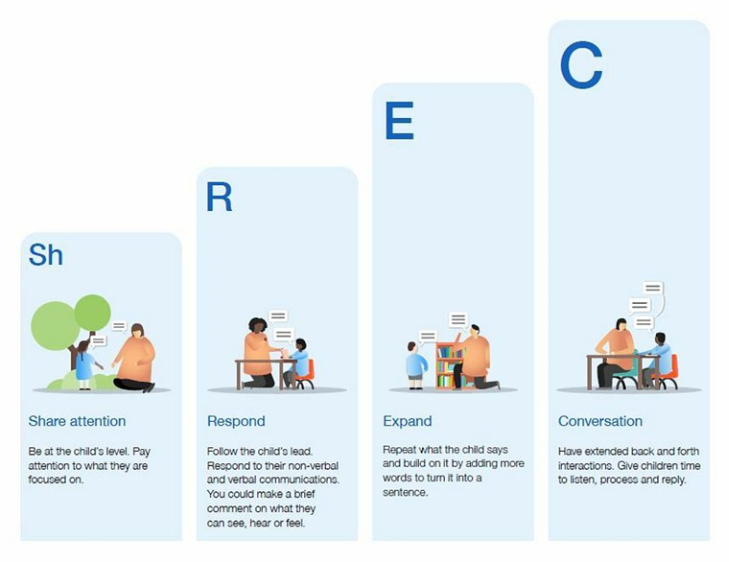
- Adults use the SHREC approach to support and encourage high quality interactions in the Early Years: